
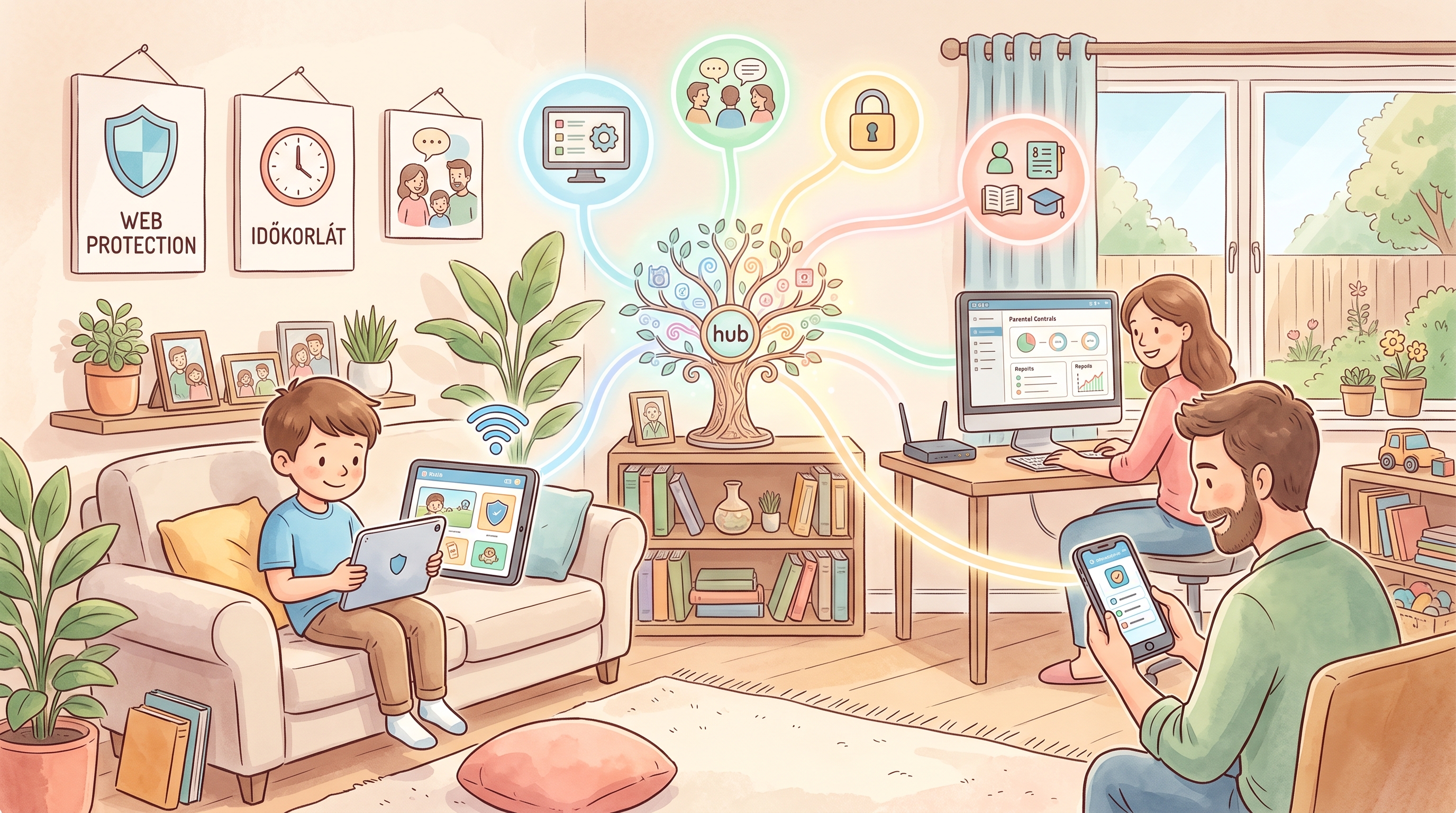
Most internet service providers in Hungary are already required, or will soon be required, to provide free internet service filtering pornographic content. While the online space can be made safer for children through this and other technical solutions, experts from the National Media and Infocommunications Authority (NMHH) warn that even the best software cannot replace dialogue between parent and child, as well as setting rules together.
When using digital devices, parental control features provide a safety net for children, helping uphold the boundaries established by the family. These tools are most effective as part of a broad parental strategy that organically incorporates educating the child and active parental mediation. Technical settings help prevent age-inappropriate content from appearing on the screen, while also enabling parents to track screen time and the usage of specific applications.
Parents can intervene at multiple levels to protect their children. The first level is filtered internet, which can be requested free of charge from service providers. Under applicable regulations, in addition to mobile internet providers, fixed-line providers with more than ten thousand subscribers are required to provide this starting May 1, 2026, and smaller providers starting in 2027. This solution blocks access to pornographic websites at the network level and often offers supplementary time-limit settings.
The second level consists of filtering software and parental control applications that can be installed on smart devices or computers. In addition to content filtering, these provide features such as location tracking or detailed usage reports. Such solutions include Google Family Link or the built-in features of operating systems. It is also important to know application-specific settings, for instance on TikTok or Instagram, where restrictions—such as disabling messaging or commenting—can be set for child safety. Configuration options for various applications and social networks can be explored on gyerekaneten.hu.

When choosing the right software, it is worth considering the operating systems used in the household, the number of devices to protect, and which software best fits the family's needs. The renewed filtering software catalogue of the NMHH assists with this by presenting popular programs in one organized place, comparing key features, and aiding selection. It is recommended to consult the accompanying guide, which clearly explains the technical background and functions of digital protection.
NMHH experts recommend establishing digital house rules together with children prior to or alongside software setup. This ensures technical protection is not perceived merely as prohibition, but rather as a collaborative, safe framework adaptable to the child's age and maturity. Remember: technology supports, but true safety comes from supportive parental presence.

You can also create your own digital household rules using guidance from NMHH's Online Heroes, with downloadable templates available on onlinehosok.hu. Additional useful advice regarding mindful media consumption can be found on gyerekaneten.hu, where NMHH informational publications for children and parents are also accessible.
The NMHH filtering software catalogue and accompanying guide provide further practical support for families in selecting and implementing effective digital safety solutions.